
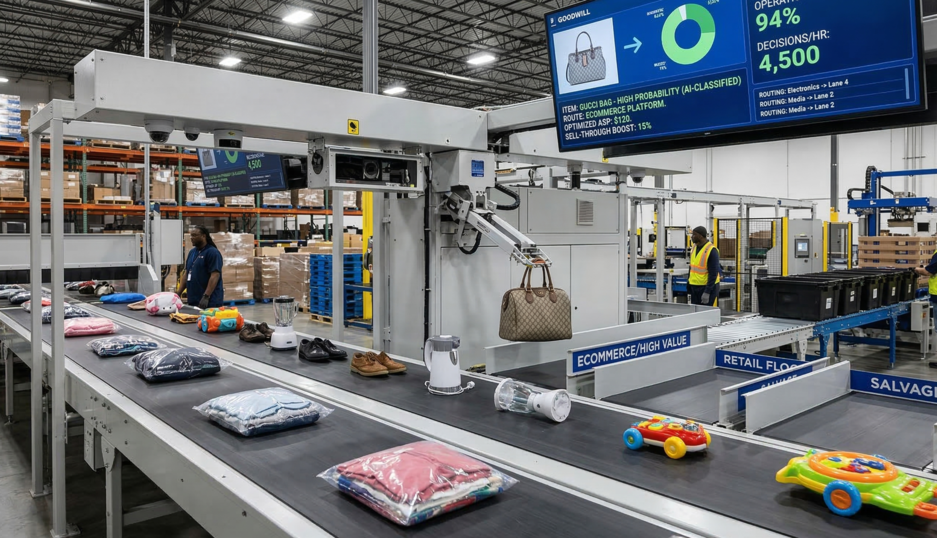
Beyond Speed: Why the Future of Goodwill Sorting Is Decision Automation
TL;DR Summary
The next evolution of Goodwill sorting is not faster hardware, it’s automated decision intelligence.
Phase One: Movement
The first wave of modernization focused on throughput.
Sorting hardware standardized intake and increased processing speed.
That solved the physical bottleneck.
But it did not solve the decision bottleneck.
The Remaining Constraint: Human-Dependent Judgment
Even in modernized operations, pricing and routing often depend on:
- Brand familiarity
- Experience level
- Local practices
- After-the-fact reporting
This creates variability.
And variability creates revenue drift.
When decisions vary:
- ASP becomes inconsistent
- Sell Through fluctuates
- Channel mix shifts unintentionally
- Leadership loses predictability
Phase Two: Decision Automation
Hammoq integrates across:
- Sorting hardware
- POS systems
- Retail workflows
- eCommerce workflows
- Performance analytics
The result is a unified model:
Movement + Intelligence + Automated Execution
Pricing becomes standardized.
Routing becomes intentional.
Performance becomes measurable in real time.
This is not incremental improvement.
It is a structural shift in how resale organizations capture value.
Engineering Revenue Instead of Reacting to It
Without automation, teams react to reports.
With automation, teams prevent the gap.
ASP improves systematically.
Sell Through stabilizes.
Productivity increases.
Labor is elevated, not expanded.
The future of sorting is not just faster belts.
It’s smarter decisions — made instantly.
Key Takeaways
Hardware modernization was phase one.
Decision automation is phase two.
AI integration unlocks scalable revenue control.


